Resurrected 1994 Bridgestone RB-T
In the spring of 1994 my parents bought me a Bridgestone RB-T for a cross-country (Seattle to Portsmouth, NH) ride that I was preparing to do that summer.  The previous summer I had my first experience with extended bicycle touring when I participated in a month-long  700 mile bike tour around the Olympic Peninsula in Washington State.  While that trip was van supported, my cross-country trip was not and therefore the road bike I borrowed from my cousin (a Nishiki, probably 14-speed) would not suffice.  I needed a bike that could be loaded with front and rear panniers and that had proper gearing for crossing the Rockies.  My father and I went to a number of bike shops in the greater Boston area, and we happened upon a bizarre bike shop that neither of us had even been to, and I don't know if I've been there since we purchased the bike: Farina's on Galen Street in Watertown, MA.  I say "bizarre" because not only do they sell bicycles, but they also sell lawnmowers, snowblowers and various other assorted gas-powered yard equipment.  The whole experience was markedly unremarkable in that I don't really recall much about buying the bike.  Little did my father or I know that we were to come home with a bit of a cult icon in the bike world: a Bridgestone RB-T ("T" for touring).  For those that don't know, Bridgestone was then run by Grant Petersen who currently runs Rivendell Bicycle Works, and 1994 was the last year that Bridgestone sold bicycles in America.  Considering that I grew up in Newton, we should have gone to Harris Cyclery, home of Sheldon Brown, but we lived in a different part of the city, and I guess that Harris wasn't really on our radar.  Sheldon has a whole section on his site devoted to Bridgestone, including all of the catalogs up to 1994 when they ceased operations in the US.  Here is the page from the brochure depicting what my bike looked like when I got it.
1994 Bridgestone Catalog Page (from Sheldonbrown.com)
I went off to college in Portland, Oregon and chose to bring my father's old beater Specialized Rock Hopper rather than the RB-T, which stayed in my parents' basement.  I put slicks on the Rock Hopper and it served its purpose as a college bike admirably, although it got ridden much less than one would imagine considering how much I currently ride and that I was living in Portland.
I subsequently moved to Atlanta for grad school and I brought the Rock Hopper rather than the RB-T.  I didn't ride much while I lived there as that city is so car-centric.  Were I to live there now I would ride, but at the time it just wasn't part of my plan.
I moved back to Boston in 2006, settling into life in JP.  I began riding regularly within 6 months-or-so and I retrieved the Bridgestone from the basement and it became my primary ride for a while.  The wheels were screwed up and I bought some Ritchey deep-section wheels with bladed spokes from Nashbar that ultimately looked ridiculous on it.  I then built up a fixed-gear and that became my primary ride during my blossoming bike obsession over the following 5 years.
A Beauty Reborn
The Bridgestone became my winter bike and was a bit neglected.  As I began to appreciate the beauty of this bike, I realized that at some point I would like to do a complete rebuild of the bike.  When I first resurrected the bike when I moved back to Boston I had gone in to International Bike to ask them what they thought it needed.  I was told that it was not worth putting any money into it, that I should just buy a new one.  Needless to say, I didn't take their advice, and I began to see that there are numerous types of bike shops, not all of which have a philosophy about cycling that is one I agree with.  I'll save more on that for another post.
The pictures here are of the completed project.  It is the first bike that I have ever built entirely by myself from the ground up (not including the frame (obviously) and the wheels which I had built for me).  It was an amazingly fun activity, and was all the more rewarding considering that I rode this bike across the country so there is obviously some sentimental attachment.  While this might be heresy for some who think that bikes like this should be restored with period perfect parts: I actually think the bike is more beautiful than it was the day it was new, and any parts that I have added (as opposed to reusing) are certainly superior to the original equipment.
So here is the part-by-part breakdown of my rebuild:
Tange double butted tubing on the RB-T. The paint is in remarkably good condition considering that the bike is almost 20 years old.
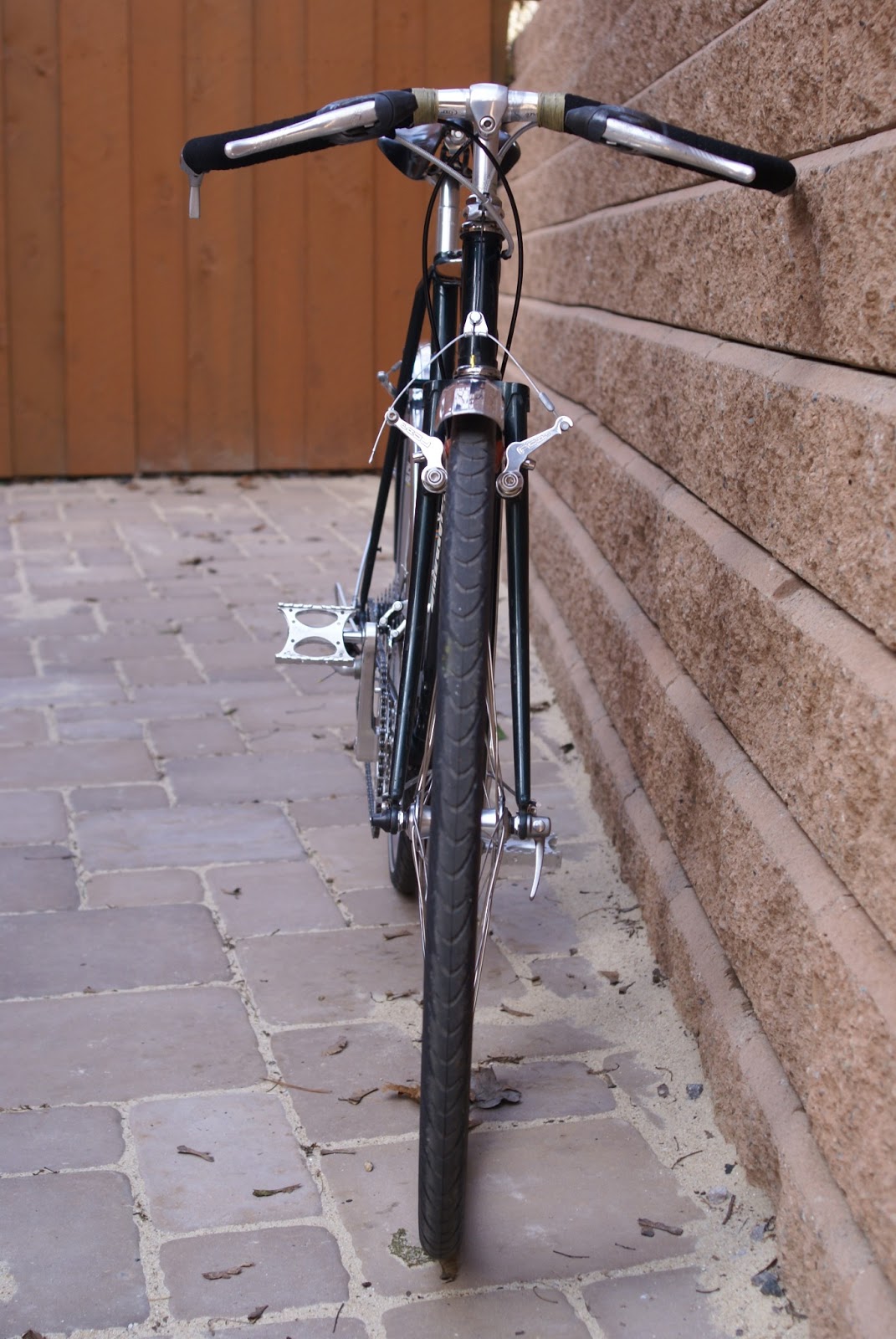
I replaced the original triple crankset with a Fluted Triple 24x34x48T from Velo Orange.  This give the bike lower gearing than it originally came with, as the bike previously had a 52T large ring.  The front derailer (Sheldon spelling...) is the original Shimano RX100 clamp-on.  The pedals are Velo Orange City Pedals that I had sitting around, they will probably be swapped for something a little larger or something with SPD compatibility.  I used new VO bottom bracket as well, as the spacing was different for this crankset relative to the original.
The rear derailer is the original Shimano RX100.  The RB-T came as a 7-speed drivetrain, but it is increasingly hard to find decent parts that are 7-speed, and there was really no reason not to go up, so I have changed to an 8-speed SRAM PG-850 11-30T cassette.  Because I am running the original barcon shifter in friction mode, there is no problem making this switch.  The chain is a Wipperman ConneX 808.
Mavic A319 rims are new. Double-butted stainless steel spokes with brass nipples laced to...
Ultegra 32H front hub laced 3X, and...
Ultegra 32H rear hub laced 3X. These wheels were hand-built by www.bicyclewheelwarehouse.com.  I would have preferred to have them built locally, but I saved a ton of money on these and I was already spending too much money as it was.  I still need to cut the fender stays.
American made Paul Components Touring Canti with polished finish up front.  Another serious upgrade from the original brakes.  Front fender is a 52mm Velo Orange Zeppelin.  The headset is original, mainly because it seems like it is in decent shape, I serviced it with the help of Broadway Bicycle School a number of years ago, and I don't have the proper tools to remove it myself.  If this one ever needs replacing, I'll put a Chris King in there.
Paul Components Touring Canti with polished finish in the rear too.  Same VO 52mm Zeppelin fender.  Paul gives you a pair of salmon Kool Stop pads when you buy their brakes.  It's the least they can do considering how expensive they are...
Brooks B17 saddle.  This is much better than the Avocet saddle that the bike came with.  That thing made it hurt to pee!
A little Japanese flair: an NJS stamped Nitto Jaguar SP-72 27.0mm seatpost that I ordered off Ebay from a guy that sells used Kerin gear.  You know you are a bike dork when you get excited about a seatpost, and this one is a beauty.  I have a Jaguar on my Iglehart (in 27.2mm guise) too and it is much more appropriate for this bike than a Thompson IMHO.  The original seatpost was an ugly cheapo giveaway.  All parts that I did not reuse that were still functional were given to Bikes Not Bombs.  The brake cable hanger is original.  The kitty sticker is not.
I'm pretty proud of this piece of improvisational bicycle mechanics, and I really hope that this was my idea and that I didn't see it somewhere a long time ago, filing it away for a time when I would need it, because I think it is slick as hell:  the rear fender is mounted to the brake bridge using an old threaded presta tube valve as the connector between the frame and the "L" bracket.  The VO fenders come with 2 brackets for the rear fender, one that wraps around the fender, and one that requires you to drill into the fender and then screw the "L" bracket into the fender from beneath.  I originally used the former, but it looks ugly, and I had tire clearance issues with it.
I used 3 of the screws that typically go on a presta valve and some of the extra leather washers I had.  This is rock solid so far, and looks pretty killer if you ask me.
Nitto Pearl 110mm 1" threaded quill stem.  I considered going for a matching Jaguar, but the slope of the Jaguar stem is really severe and considerably more expensive.  The Pearl is still a gorgeous stem with that sheen that Nitto is known for.  For some reason the RB-T originally came with a black stem.  I have no idea what the aesthetic thinking was for that, because it looked awful from day one.  This is a major aesthetic upgrade.  Original Shimano barcon bar end shifters set to friction mode to accommodate the 8-speed drivetrain (and because that's how Grant says you should use them).
In true Grant Peterson fashion, I used moustache-style bars and finished the bar tape with waxed thread.  I had an extra pair of Soma Oxford bars, so these are not the Nitto Moustache that Grant designed, but they are close.  I have them turned down.  The brake levers are the original Shimano SLR Exage.  Bar tape is a retro perforated felt-like variety.  You can see that I had to use a Nitto stainless stem shim in there to change from the 26.0mm stem to the 25.4mm bar clamp area.  This was the result of a mislabeled Ebay purchase that I was none to happy about.  I wound up scratching the handlebars pretty good trying to get that thing in there. Oh well.  The front brake cable hanger is original.
Schwalbe Marathon Supreme 700x35c.  It turns out that these are really like a 37c, and that therefore the 45mm fenders that I originally purchased would not fit as there was tire rub.  From everything I've read about these tires they are great. I think I've officially been converted from a Conti man to a Schwalbe man.  All my bikes have them now, including the Marathon Winter studs which are great btw.
From the front
From the back
I couldn't be more pleased! See you on the road.


A few weeks ago, a skinny stripe of paint appeared on the SW corridor path. I assumed it was someone who felt like riding around dribbling paint from their bike, and that maybe it was the beginning of something bigger.

Then yesterday I read this article in the NY Times about a Brooklyn-based graffiti artist named Momo that has scribbled his name along the sidewalks across Manhattan in a very similar fashion. His tag stretches from one side of the city to the other. I have not had a chance to explore whether the paint here extends much past Mass Ave. Has anyone else noticed this paint on bike paths (or sidewalks or streets) in the city?
Here's a map from the Times:


And here is an image from the Times of his paint drips, looks pretty similar to the image above:
I made the following comment in response to a post on BostonBiker, but I'm reposting it here for people who do not read the comments on his posts:

For background, this article appeared in the Globe yesterday.

As much as I want to be excited about this, I can only react with disappointment. As I noted at the end of May (http://rollinginboston.bostonbiker.org/2010/05/28/wheres-the-bike-share/) it’s been pretty obvious that the bike share program is getting off to a rough start. I’ve been willing to give Nicole and the rest of the Boston Bikes people (including I guess Mumbles) the benefit of the doubt that there was a good reason for the delay. Their inclination to hold off on starting the program until it can be launched with an adequate number of bikes is a good one, but 500 bikes is not even remotely close to enough.
I spent last July in Paris and used Velib on a daily basis, and I have reports of my experience on my blog. At every station, at least 10-20% of the bikes were not functioning due to flat tires (which are not user repairable as it takes a special tool to remove the wheels in order to deter theft), wonky drive-trains or any of the other myriad number of things that can happen to a bicycle. Assuming the same conditions here, that would leave 400-450 bikes in circulation at any given time.

According to Wikipedia, Paris covers an area of around 41 sq. miles, with a population of ~2.2 million. Boston on the other hand, covers a similar geographical footprint (48 sq. miles) but contains a much smaller population (~600,000). If Boston were to implement a program with a similar bikes/population ratio, that would imply ~5,000 bikes here. The proposed bike share is an ORDER OF MAGNITUDE off. The geographical similarities however, remain. Paris has 750 stations. Boston is proposing 50. Again an order of magnitude difference. I noticed that the real benefit of the Velib system was the ability to return a bike nearly anywhere in the city, and that will be plainly impossible with the current proposal.

If this is going to be a system intended primarily for tourists, with bikes primarily located downtown, then Nicole needs to just state that. But don’t try to say that we’re going to have a city-wide system; it’s just not feasible unless a complete commitment is made.

If this is going to be tied to MBTA subway stops (not a bad starting point) then there are very few bike stations left for areas that are not at a subway stop (I’m thinking large swaths of Dorchester, Roxbury, JP, Roslindale, etc).

In summary, I completely support the effort to bring bike-share to Boston, but it is another case of Boston half-assing an infrastructure project that will ultimately leave many people disappointed and left out.


Come on out to Copley Sq. this evening to ride with ~300 cyclists through the streets of Boston. People generally start to arrive around 5:30, and the ride usually leaves by 6 pm. If you have never ridden in a CM before, a few details:

-There is no pre-established route
-It is easily the safest cycling experience you can have in the city, as cars are forced to wait for the large group of people
-It is extraordinarily liberating, and a fabulous way to enjoy the company of friends, and fellow cyclists.
-Contrary to popular belief, you do not have to ride a fixie, have tats, or be in college in order to fit in (in fact, I think one of the most common occupations of riders that I've encountered is lawyers...)
-It is a rolling celebration of everything cycling

see you there!

The work that was done on the SW Corridor last spring was pretty half-assed, so I was happy to see markings all along the path (at least from Stoneybrook to the South End) on my commute this AM. This work is particularly crucial for 4-season users of the path, as it is in the rough areas where ice tends to form in the winter.

Also, I came across the aftermath of a bike accident on the SW corridor this AM. I didn't see the rider, as he/she was already loaded in the ambulance, but the bike looked fine and the cop told me they were OK. Let's hope that's the case, feel free to post any updates if you have them.

Ride Safely.

Check out this video of some kids in Oakland that put colored tape in their spokes, creating neat patterns as they ride. It's great to see that bikes are being used to promote peace in the community, and give kids skills that they can employ in their future if they so choose. Maybe these will overtake Lincoln '64 lowriders and Toyata Priuses (Prii?) as the vehicle of choice in the Bay Area...

I haven't seen this phenomenon in Boston yet, but I'm sure it's only a matter of time.

Scrapertown from California is a place. on Vimeo.

The bike path along Melnea Cass is one of those routes in Boston that was somehow created years ago despite any larger provisions for bicycles in the city at the time. It's also in been in awful condition ever since I first rode on it 4 or 5 years ago. I don't ride on it too often, so I'm not sure how recent a development this is, but I noticed yesterday that a small portion has been recently re-paved. There are still many areas that need A LOT of work, but hopefully this is a sign of things to come. Melnea Cass is one of those streets that you really don't want to ride on, so the integrity of the path is crucial here.

Happy Riding